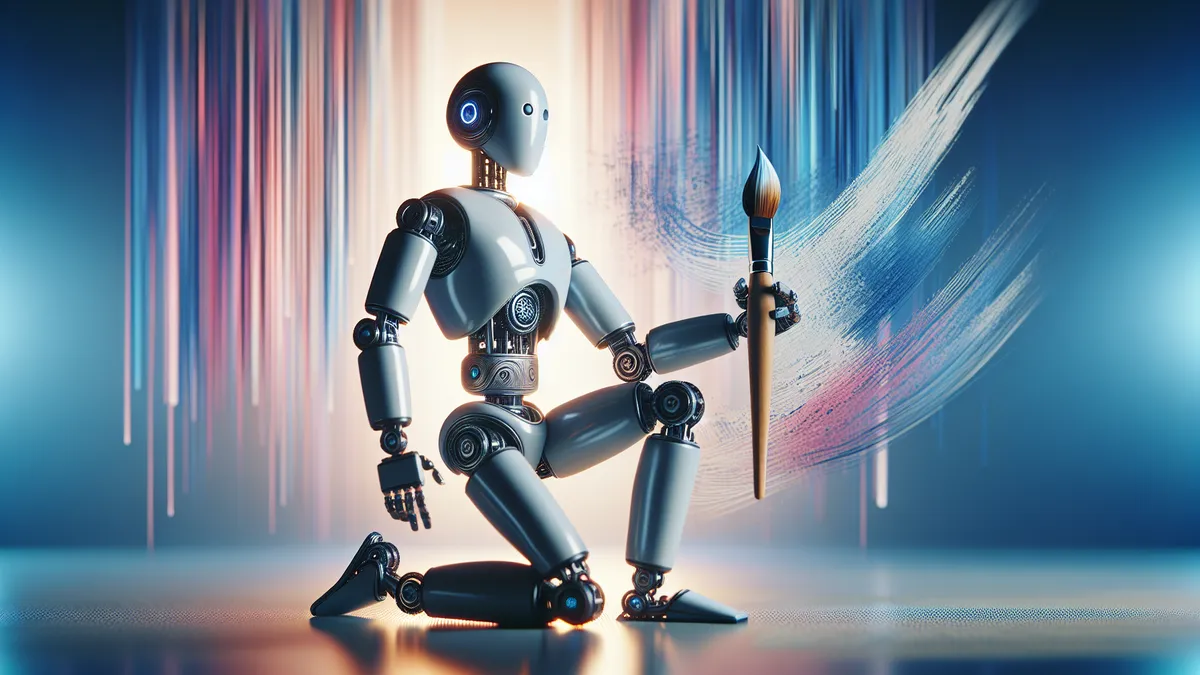
Creative AI: Enabler or Crutch in 2026's Artistic Arena?
Creative AI in 2026: Bridging the Art-Tech Divide
The artistic world in 2026 is at a fascinating crossroads. Artificial Intelligence is not just a whisper in the winds of creativity anymore; it's a boisterous presence, challenging and collaborating with human creators. While AI's capabilities expand, questions about its role as either an enabler or a crutch continue to provoke debates among artists, critics, and technologists.
AI's infiltration into music, design, film, and literature varies greatly, influencing how art is created, consumed, and critiqued. Each field experiences AI's touch differently—some embrace it as an assistant, others resist it as an intruder. It's this diversity in application and opinion that makes the discussion endlessly intriguing and, let's be honest, a bit contentious.
Gone are the days of AI merely producing quirky art or generating background music tracks; today's AI can co-create, analyze, and even critique. Yet, the question remains: is this just a new brush in the artist's toolkit, or is it something more threatening? To answer this, we need to look at each industry individually, starting with music.
AI's Role in Music: More Than Just Beats?
AI has been remixing, producing, and even composing original music for years now, with companies like Amper Music and AIVA pioneering in algorithmic composition. But the real innovation lies in how AI is being used today—not just to spit out tunes but to craft entire symphonies that resonate with human emotion. AIVA, for instance, claims that its compositions are not merely formulas but carry the nuanced emotional weight of a human composer.
However, skepticism persists. Critics argue that AI lacks the 'soul' of music, an element that can't be quantified or coded. Yet, the commercial music industry, driven by efficiency and cost, sees AI as a valuable tool. Sony's Flow Machines, a product that aids in songwriting, is utilized by numerous artists to test new ideas quickly and efficiently without replacing human creativity entirely.
In concert performances, AI is even credited as a co-performer. Tools like Google's NSynth have enabled musicians to create entirely new sounds that a traditional instrument could never produce. Despite such advancements, purists worry about the over-reliance on tech, fearing a homogenized sound in an industry that thrives on individuality.
Design and AI: Brushes or Bots?
In the world of design, AI's contributions are both lauded and lamented. Tools like Adobe Sensei are increasingly prevalent, offering designers capabilities like automated image tagging and predictive analytics to streamline workflows. Though handy, these tools have some designers questioning if AI will eventually replace human touch in aesthetics.
Yet, it's not about replacement but augmentation. Figma's AI-driven features, for example, assist in generating design variations rapidly, allowing designers more time to focus on decision-making rather than iteration. This is particularly significant in industries where time and creativity are tightly bound like advertising and web design.
"AI is not stealing creativity; it's the ultimate collaborator, liberating designers to focus on what truly requires a human touch." — A leading digital artist.
However, the debate intensifies when considering the ethical implications of AI-designed works. Who owns the design? The person who instructed the AI or the AI itself? As AI becomes more autonomous in design roles, this question will only become more complex.
Film and AI: Director's Best Friend or Foe?
Filmmaking is yet another battleground where AI's role is rapidly evolving. AI tools like ScriptBook claim to forecast a script's success before a single scene is shot, allowing studios to avoid costly flops. While this promises efficiency and fiscal prudence, it also raises concerns about artistic freedom and originality.
In visual effects, AI has stepped in as a cost-effective solution, performing complex renderings that would take humans weeks to accomplish in mere days. Companies like Weta Digital employ AI to enhance CG effects, creating stunning visuals without ballooning budgets. Although beneficial, there's an ongoing debate about job displacement and the loss of artistic craftsmanship.
Perhaps the most controversial use of AI in film is in editing. AI programs that sort and cut footage based on predetermined criteria are challenging the traditional roles of editors, previously celebrated for their subjective, nuanced contributions to storytelling. As AI becomes more sophisticated, distinguishing between automated and human creativity in film will be increasingly difficult.
Literature: AI as Co-Author, Not Lead
AI's foray into literature is perhaps the most contentious. While tools like OpenAI's GPT-3 have proven capable of generating prose that mimics human writing, the question of whether AI can truly understand and craft narratives remains hotly debated. In 2026, we're seeing AI assist authors by generating ideas, suggesting plot twists, or even writing entire chapters.
However, the fear that AI will replace authors is largely unfounded. AI lacks the ability to weave intricate psychological insights or deeply personal experiences into a narrative. It's a sophisticated tool for overcoming writer’s block, not for creating the next great American novel.
| Tool | Capability | Industry Use |
|---|---|---|
| AIVA | Music Composition | Film Scores, Commercial Music |
| Adobe Sensei | Design Automation | Advertising, Digital Media |
| ScriptBook | Script Analysis | Film Production |
| GPT-3 | Text Generation | Literature, Content Creation |
The use of AI in writing is like having a spellchecker on steroids. It refines, suggests, and even praises—but it cannot replace the indescribable human essence that flavors every good story. Authors in 2026 see AI as a co-author at best; a tool that must be managed carefully to prevent it from overshadowing the human elements that make literature compelling.
The Advertising Arena: AI's Double-Edged Sword
In 2026, AI's impact on advertising is undeniable. Algorithms are fine-tuning strategies, optimizing ad spend, and predicting consumer behavior with an uncanny accuracy that was once thought impossible. Platforms like Google's AI-driven ad solutions are lauded for delivering more personalized experiences. But is this a triumph for creativity, or just cold data-driven marketing?
Sure, AI can analyze vast datasets to find when you’re most likely to click "buy now." And yes, it can automate A/B testing at a scale no human team could feasibly manage. However, at its heart, advertising is about storytelling, which is something AI still struggles with. As AI takes over the more mechanical aspects of advertising, the human touch becomes more vital than ever to create campaigns that resonate emotionally.
"While AI can tell you what customers want, only a human can show them why they should care." — A leading marketing strategist.
On the list of AI's top contributions to advertising, data analysis and real-time bidding systems reign supreme, yet they also highlight a critical downside: the risk of over-optimization. When everything becomes a statistic, the unique and quirky elements that elevate a campaign can be lost in the shuffle. In a sea of perfectly targeted ads, how do brands stand out?
FAQ: How does AI affect job roles in advertising?
While AI streamlines routine tasks, creative roles remain vital. However, employees are required to adapt, focusing on strategy and storytelling skills over manual ad placements.
Contrarian Views: Where AI Limps
For all its advancements, AI doesn't have the Midas touch. While it shines in data-heavy industries, its weaknesses show in fields requiring empathy, ethics, and deep cultural understanding. In 2026, we see growing concerns about AI's limitations, particularly in areas like ethics in advertising and cultural sensitivity in global campaigns.
Critics argue that AI's decision-making lacks the nuance required for ethical judgments. Take, for instance, Facebook's algorithmic blunders in moderating content—missteps that have led to legal challenges and public outrage. This begs the question: should AI be trusted with decisions that impact societal norms and values?
- AI's lack of empathy and ethical reasoning
- Over-reliance on algorithms risking cultural insensitivity
- Potential for bias in data sets leading to skewed outputs
AI might be able to produce a symphony, design a logo, or write a script, but it can't feel the euphoria of a crowd, perceive the subtext of a delicate situation, or understand the cultural depth of a narrative. These are areas where humans, with all their imperfections, still reign supreme.
FAQ: Are there fields where AI should not be used?
Areas requiring moral and cultural judgments, such as content moderation and sensitive advertisement placements, should maintain significant human oversight to avoid potential ethical pitfalls.
Conclusion: Human Soul vs AI Efficiency
As we navigate 2026, it's clear that AI is both an enabler and a crutch. In industries from advertising to film, AI provides tools that enhance human creativity but also expose our reliance on technology. This dual nature forces us to consider what we value more: the efficiency of AI or the irreplaceable soul of human creativity.
It's tempting to lean into the ease and precision AI offers, but we must balance this with an appreciation for the unpredictable, often messy, but deeply human elements that AI simply can't replicate. The future of creativity isn't about choosing one over the other, but integrating AI as a powerful collaborator while cherishing the ineffable qualities that define human artistry.
"AI can mimic, enhance, and automate, but it will never replace the human spark that ignites creativity's true brilliance." — An influential art critic.
As we continue to experiment with AI's capabilities, we must remain vigilant guardians of our own creative processes. At the end of the day, AI is not the enemy but a tool—a tool that, like any other, is only as valuable as the hands that wield it. Let us use it wisely.