Quick Take
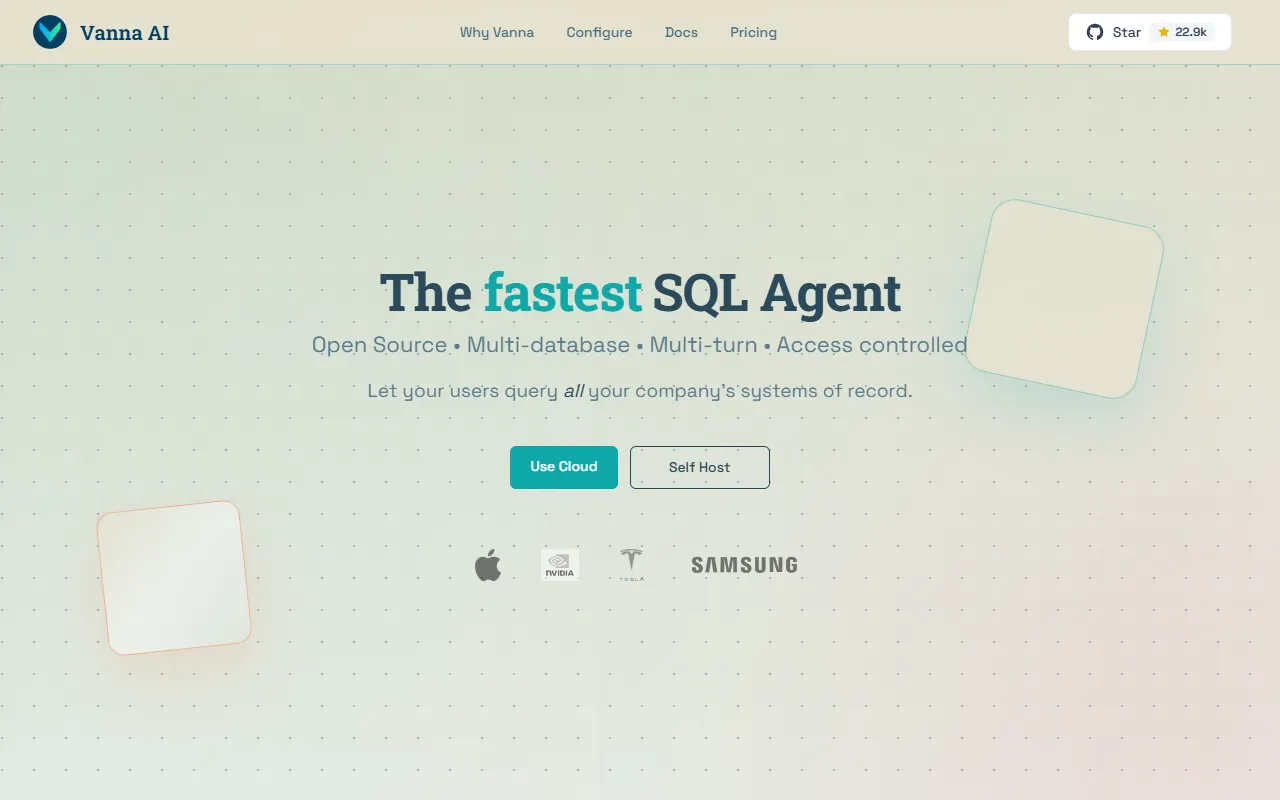
Personalized AI SQL agent for querying databases using natural language.
Pricing
FreemiumTool Overview
Tags

What is Vanna.ai?
Vanna.ai is an open-source AI SQL agent that enables users to generate accurate SQL queries from natural language questions by training on an organization's specific database schema, documentation, and query patterns. Unlike generic text-to-SQL tools that attempt to generate queries from general knowledge, Vanna.ai creates a custom model for each database that understands the specific tables, columns, relationships, naming conventions, and business logic unique to that organization. This training-based approach results in significantly higher accuracy than one-size-fits-all solutions, particularly for complex enterprise databases with domain-specific terminology and non-obvious data relationships.
The platform was created with the understanding that the primary challenge in text-to-SQL is not generating syntactically correct SQL but generating semantically correct queries that accurately reflect the user's intent given the specific context of their database. A question like "show me revenue by region" could translate to dozens of different SQL queries depending on how revenue is calculated, how regions are defined, which tables contain the relevant data, and what business rules govern the relationship between these concepts. Vanna.ai solves this problem by learning these context-specific details from training data provided by the organization.
Vanna.ai is available as both an open-source Python package that developers can integrate into their own applications and as a hosted service that provides a ready-to-use interface. The open-source nature of the project means organizations can inspect the code, customize the behavior, and deploy it within their own infrastructure with full control over data privacy and security. The platform supports all major SQL databases and integrates with popular data tools, making it flexible enough to fit into virtually any data stack. The project has gained significant traction in the data community, with a growing number of organizations adopting it as their primary natural language interface to their databases.
Key Features
Custom Model Training: Vanna.ai's most distinctive feature is its ability to be trained on an organization's specific database context. Users provide training data in the form of DDL statements that describe the schema, documentation that explains business logic and terminology, and example question-SQL pairs that demonstrate the correct translations for common queries. The model uses this training data to build a contextual understanding that dramatically improves query accuracy compared to generic approaches that lack this domain-specific knowledge.
RAG-Based Architecture: Vanna.ai uses a Retrieval-Augmented Generation architecture where the trained model retrieves relevant context from its training data before generating SQL. When a user asks a question, the system identifies the most relevant schema definitions, documentation, and example queries from its training set and uses this context to inform the SQL generation process. This RAG approach combines the flexibility of large language models with the precision of domain-specific knowledge retrieval.
Auto-Visualization: After generating and executing a SQL query, Vanna.ai automatically creates appropriate visualizations of the results using Plotly charts. The system analyzes the structure and content of the query results to determine whether a bar chart, line chart, scatter plot, or other visualization type would best represent the data. This automatic visualization eliminates the extra step of manually creating charts and helps users immediately understand patterns and trends in their query results.
Self-Improving Accuracy: The platform includes a feedback mechanism where users can indicate whether generated queries are correct, and approved queries are automatically added to the training set. This creates a virtuous cycle where the model becomes more accurate over time as it accumulates more examples of correct translations for the specific database. The more the system is used and validated, the better it becomes at understanding and translating the organization's specific data language.
Flexible Deployment Options: Vanna.ai can be deployed in multiple configurations to suit different organizational needs and security requirements. The open-source package can be used locally, deployed on private infrastructure, or run in cloud environments. The vector store that holds training data can be hosted using various providers including ChromaDB, Pinecone, or Vanna.ai's own hosted service. The LLM component can use OpenAI, Anthropic, local models, or any other compatible language model, giving organizations full control over their data processing pipeline.
How It Works
Getting started with Vanna.ai involves two main phases: training and querying. The training phase begins with providing the system with information about your database. This typically includes DDL statements that define your tables, columns, and constraints, which give the model structural understanding of the database. Additional training data can include documentation that explains business rules, data definitions, and common calculations, as well as example pairs of natural language questions and their corresponding correct SQL queries. The more comprehensive and representative the training data, the more accurate the model's query generation will be.
The training process stores this contextual information in a vector database that enables efficient retrieval during query generation. When a user asks a question, Vanna.ai performs a similarity search against the stored training data to find the most relevant schema definitions, documentation, and example queries. This retrieved context is then combined with the user's question and sent to a large language model, which generates a SQL query informed by both its general SQL knowledge and the specific organizational context provided by the training data. This RAG approach is what enables Vanna.ai to achieve significantly higher accuracy than generic text-to-SQL approaches.
Once the SQL query is generated, users can review it before execution, providing an important quality control step. After execution, results are displayed in tabular format with automatic chart generation. Users can provide feedback on query accuracy through a simple approval mechanism, which adds correct queries to the training set and improves future performance. For developers integrating Vanna.ai into applications, the platform provides a Python API that makes it straightforward to programmatically train the model, generate queries, and retrieve results. The Jupyter notebook integration is particularly popular among data scientists who want to combine natural language querying with their existing analytical workflows.
Use Cases
Self-Service Analytics for Business Teams: Organizations deploy Vanna.ai as a natural language interface that allows business users to query databases directly without learning SQL or waiting for data team assistance. By training the model on the organization's specific database and business terminology, even complex analytical questions can be answered instantly, dramatically reducing the time from question to insight and freeing data engineers from ad-hoc reporting requests.
Data Team Productivity: Data analysts and engineers use Vanna.ai to accelerate their own SQL writing process, particularly for unfamiliar databases or complex queries involving multiple joins and aggregations. The natural language interface serves as a starting point that generates a draft query, which the analyst can then review, refine, and optimize, significantly reducing the time spent constructing queries from scratch.
Embedded Database Interfaces: Software developers integrate Vanna.ai into their applications to provide end users with natural language database querying capabilities. This is particularly valuable for SaaS applications, internal tools, and data products where users need to explore and analyze data but should not be exposed to raw SQL or the underlying database structure.
Database Documentation and Onboarding: New team members use Vanna.ai to explore and understand unfamiliar databases by asking questions in natural language. The generated SQL queries serve as learning examples that help new analysts understand the database structure, common query patterns, and business logic encoding. This accelerates onboarding and reduces the dependency on senior team members for knowledge transfer.
Pricing
Vanna.ai's core technology is open-source and free to use under the MIT license, meaning organizations can deploy it on their own infrastructure at no licensing cost. The open-source package includes the full training, retrieval, and query generation pipeline, with support for various LLM providers and vector stores. Vanna.ai also offers a hosted service that simplifies deployment by managing the vector store and providing a ready-to-use web interface. The hosted service follows a freemium model with a free tier that includes a limited number of queries and training data points, and paid plans that increase these limits and add features like team collaboration, advanced security controls, and priority support. Enterprise plans with custom limits, dedicated infrastructure, and professional services are available for larger organizations. Users who prefer full control can use the open-source package with their own LLM API keys, paying only the API costs charged by their chosen LLM provider.
Pros and Cons
Pros:
The custom training approach results in significantly higher query accuracy than generic text-to-SQL tools because the model understands the specific schema, business logic, and terminology unique to each organization's database.
Open-source availability under the MIT license provides full transparency, customization ability, and the option for self-hosted deployment that keeps all data within the organization's own infrastructure for maximum security and privacy.
The self-improving feedback mechanism creates a virtuous cycle where query accuracy continuously improves through use, making the system increasingly valuable over time as it accumulates more validated query examples.
Cons:
Initial setup requires meaningful effort in preparing training data including schema documentation, business rule explanations, and example query pairs, which can be time-consuming for organizations with large, complex databases that lack existing documentation.
As a developer-oriented tool, the open-source version requires Python programming knowledge for setup, training, and integration, which may be a barrier for organizations without available development resources to implement and maintain the system.
Who Is It Best For?
Vanna.ai is best suited for data teams and organizations that want to build accurate, context-aware natural language interfaces to their databases. It is particularly valuable for companies with complex databases where generic text-to-SQL tools produce inaccurate results due to domain-specific terminology and non-obvious data relationships. Data engineering teams who want to reduce the burden of ad-hoc query requests from business users will find Vanna.ai an effective self-service solution. Organizations that prioritize data privacy and need to keep database interactions within their own infrastructure benefit from the open-source, self-hosted deployment option. Python-proficient data teams and developers are best positioned to take full advantage of the platform's customization and integration capabilities.
Why Choose Vanna.ai?
Vanna.ai stands out in the text-to-SQL space by recognizing that accuracy requires context, and context requires training on the specific database being queried. While generic AI tools may impress with demos on simple databases, they often fail when confronted with the complexity of real-world enterprise data. Vanna.ai's training-based approach solves this fundamental problem, delivering accuracy levels that make natural language querying genuinely practical for production use. The combination of open-source transparency, flexible deployment options, self-improving accuracy, and the ability to integrate into existing data tools and applications makes Vanna.ai the most pragmatic choice for organizations that want to build reliable, accurate natural language interfaces to their databases.
ADVERTISEMENT
728 x 90
Browse More Tools
View all
Connected Papers
Research ToolsVisual tool for exploring academic paper connections and building literature graphs.

Ironclad
Legal AIAI-powered contract lifecycle management platform for enterprise legal teams.
MindsDB
Data AnalyticsAI platform that brings machine learning directly into your existing databases.
AI Shirt Design Generator - YupTees
AI Image GenerationYupTees: AI-powered T-shirt design generator for fast, easy, and scalable print-on-demand creations.
Claude
AI AssistantsAnthropic's AI assistant known for thoughtful, nuanced responses, strong reasoning capabilities, and a focus on safety and helpfulness.

AlphaFold
Science AIDeepMind AI system that predicts 3D protein structures with remarkable accuracy.

Cursor
Code AssistantsAn AI-first code editor built on VS Code that integrates AI deeply into every aspect of the coding experience, from writing to debugging.
ChatGPT
AI AssistantsOpenAI's conversational AI assistant capable of generating text, answering questions, writing code, and assisting with a wide range of tasks.

Claid.ai
Image EditingAI product photo editing with automated background removal, upscaling, and enhancement.