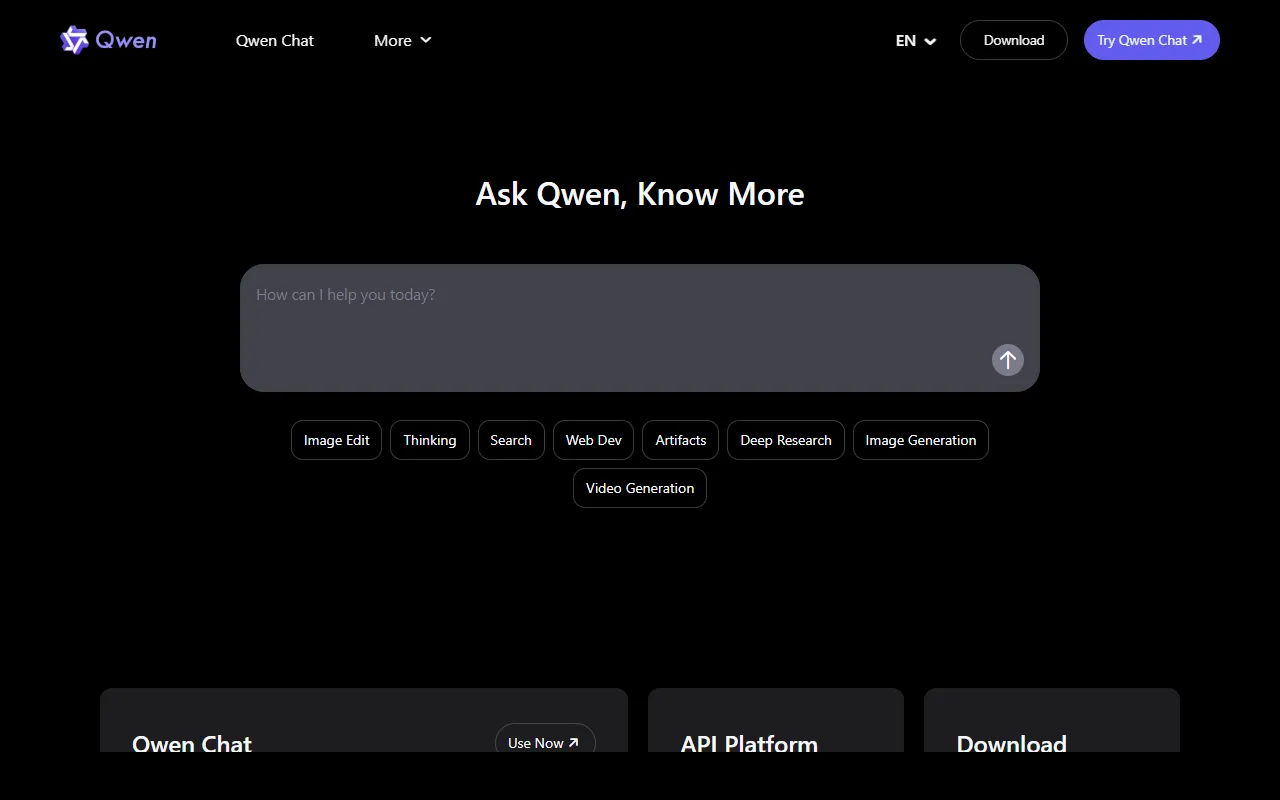
Quick Take
Multilingual large language model by Alibaba supporting 119 languages with integrated tools.
Pricing
FreeTool Overview
Tags
What is Qwen?
Qwen (pronounced "chwen") is a family of large language models and multimodal AI models developed by Alibaba Cloud, the cloud computing arm of Chinese technology giant Alibaba Group. First released in 2023, Qwen has rapidly established itself as one of the most capable and versatile open-source AI model families available globally. The name Qwen is derived from Tongyi Qianwen, which translates roughly to "seeking answers from a thousand questions," reflecting the model's ambition to serve as a comprehensive AI assistant capable of addressing virtually any query or task across an extraordinary range of languages and domains.
What makes Qwen particularly remarkable in the AI landscape is its exceptional multilingual capability, supporting 119 languages and dialects out of the box. This makes it one of the most linguistically diverse AI models ever created, capable of understanding and generating text in languages ranging from major world languages like English, Chinese, Spanish, and Arabic to less commonly supported languages. This broad language support, combined with strong performance on international benchmarks, has made Qwen a popular choice for developers and organizations operating in multilingual environments or serving global audiences.
Alibaba Cloud has made Qwen available as an open-source project, releasing model weights under permissive licenses that allow both research and commercial use. The Qwen family includes models of various sizes, from compact models suitable for edge devices to massive models that rival the capabilities of the largest proprietary systems. The ecosystem also extends beyond pure text models to include Qwen-VL for vision-language tasks, Qwen-Audio for audio understanding, and Qwen-Code for programming assistance, creating a comprehensive suite of AI capabilities built on a shared architectural foundation.
Key Features
Massive Multilingual Support (119 Languages): Qwen's support for 119 languages is not merely tokenizer-level recognition but genuine comprehension and generation capability across this vast linguistic spectrum. The model can translate between languages, answer questions posed in any supported language, generate content in multiple languages within the same conversation, and handle code-switching naturally. This makes it exceptionally valuable for international businesses, researchers working with multilingual data, and developers building applications for diverse global markets.
Open-Source Availability: Unlike many leading AI models that are locked behind proprietary APIs, Qwen's model weights are freely available for download and deployment. This means organizations can run Qwen on their own infrastructure, fine-tune it for specific use cases, and integrate it into products without ongoing API costs or dependency on a third-party service. The open-source nature also enables the research community to study, improve, and build upon the model's capabilities.
Scalable Model Family: The Qwen family offers models at multiple parameter sizes, from lightweight versions with a few billion parameters that can run on consumer hardware to massive versions with hundreds of billions of parameters that deliver state-of-the-art performance. This scalability allows users to choose the right trade-off between performance and computational cost for their specific needs, whether that means running a small model on a laptop or deploying the full-size model on a GPU cluster.
Advanced Reasoning and Coding: Qwen demonstrates strong performance on reasoning benchmarks, mathematical problem-solving, and code generation tasks. The model can handle complex multi-step reasoning chains, solve challenging mathematical problems, and write code in dozens of programming languages. Specialized variants like Qwen-Coder are specifically optimized for software development tasks and consistently rank among the top open-source coding models available.
Multimodal Capabilities: Beyond text, the Qwen ecosystem includes models capable of understanding images, video, and audio. Qwen-VL can analyze photographs, interpret charts and diagrams, read text in images, and answer questions about visual content. Qwen-Audio can transcribe speech, understand audio content, and respond to voice-based queries. These multimodal extensions share the same underlying architecture, making them easy to integrate and deploy alongside the core language model.
How It Works
Accessing Qwen can be done through several pathways depending on your technical expertise and requirements. The simplest approach is through Alibaba Cloud's Model Studio platform, which provides a web-based chat interface similar to ChatGPT where you can interact with Qwen directly in your browser without any setup or installation. This is ideal for quick experiments, testing the model's capabilities, and casual use across any of its supported languages.
For developers who want to integrate Qwen into their applications, Alibaba Cloud offers API access through its DashScope service, which provides standard REST endpoints compatible with the OpenAI API format. This means that existing code written for OpenAI's API can often be adapted to use Qwen with minimal changes. Alternatively, since Qwen is open-source, developers can download the model weights from platforms like Hugging Face and run the model locally using popular inference frameworks such as vLLM, Ollama, or llama.cpp. Local deployment provides complete control over the model, eliminates per-token API costs, and ensures data privacy since no information leaves your infrastructure.
Fine-tuning Qwen for specific use cases is also straightforward thanks to the open-source ecosystem. Using tools like Hugging Face Transformers, LoRA adapters, or Alibaba's own training frameworks, developers can customize Qwen's behavior for specialized domains such as medical advice, legal analysis, customer service, or any other application where domain-specific knowledge and tone are important. The community has produced numerous fine-tuned variants of Qwen, and many are shared publicly for others to use and build upon.
Use Cases
Multilingual Customer Support: Businesses operating across multiple countries use Qwen to power customer service chatbots that can seamlessly handle inquiries in dozens of languages without requiring separate models for each language. The model's ability to understand context, cultural nuances, and language-specific idioms makes it particularly effective for delivering natural, helpful support experiences to a global customer base.
Software Development and Code Generation: Developers use Qwen and its specialized Qwen-Coder variants for writing code, debugging existing programs, generating unit tests, and translating code between programming languages. The model's strong coding performance across languages like Python, JavaScript, Java, C++, and many more makes it a versatile programming assistant that can significantly accelerate development workflows.
Content Creation and Translation: Content creators, publishers, and localization teams use Qwen for generating articles, marketing copy, social media posts, and translating content between languages while maintaining natural tone and cultural appropriateness. The model's deep understanding of multiple languages makes it particularly effective for creating content that resonates with local audiences rather than sounding like a machine translation.
Research and Data Analysis: Academic researchers and data analysts leverage Qwen for processing multilingual research papers, analyzing datasets with text in multiple languages, summarizing large volumes of documents, and generating research insights. The model's ability to work across languages eliminates barriers that typically require multiple specialized tools or human translators.
Pricing
One of Qwen's most attractive aspects is its pricing model, which offers significant value at every level. The open-source model weights are completely free to download and use, with no licensing fees for either research or commercial applications. This means organizations can deploy Qwen on their own infrastructure and pay only for the compute resources required to run the model. For those who prefer managed access, Alibaba Cloud's DashScope API offers competitive per-token pricing that is generally lower than comparable proprietary models, with a generous free tier that includes a substantial number of tokens per month for new users. The exact API pricing varies by model size and capability, with smaller, faster models costing less per token than the largest, most capable versions. Enterprise customers can also negotiate custom pricing and dedicated deployment options through Alibaba Cloud's sales team.
Pros and Cons
Pros:
Unparalleled multilingual support across 119 languages makes it the most linguistically capable open-source model available
Fully open-source with permissive licensing allows free commercial use, local deployment, and complete data privacy
Highly competitive performance on international benchmarks, often matching or exceeding proprietary models of similar size
Comprehensive model ecosystem covering text, vision, audio, and code in a unified architecture
Cons:
Running the largest Qwen models locally requires substantial GPU resources, which can be cost-prohibitive for individual developers or small organizations
Documentation and community resources are heavily weighted toward Chinese-language materials, which can create barriers for English-speaking developers
While multilingual performance is strong overall, quality can vary across the 119 supported languages, with less common languages receiving less thorough training
Who Is It Best For?
Qwen is best suited for developers, researchers, and organizations that need a powerful, flexible AI model without the constraints and costs of proprietary alternatives. It is particularly valuable for teams working in multilingual environments, companies serving international markets, and organizations that require on-premises deployment for data privacy or regulatory compliance. Startups and individual developers benefit from the zero licensing cost, while enterprises appreciate the ability to fine-tune and customize the model for specific business needs. If you need an AI model that works across languages and can be deployed anywhere, Qwen should be at the top of your evaluation list.
Why Choose Qwen?
Qwen represents the best of what open-source AI has to offer: world-class performance, extraordinary multilingual capabilities, and the freedom to deploy, customize, and use the model however you see fit. In a market increasingly dominated by expensive proprietary APIs, Qwen provides a compelling alternative that puts control back in the hands of developers and organizations. Its 119-language support is genuinely unmatched, its performance competes with the best models available from any provider, and its open-source nature ensures that your AI strategy isn't dependent on any single vendor. Whether you're building a multilingual application, need a cost-effective alternative to proprietary AI services, or want the flexibility to run AI on your own terms, Qwen delivers on all fronts.
ADVERTISEMENT
728 x 90
Browse More Tools
View all
Connected Papers
Research ToolsVisual tool for exploring academic paper connections and building literature graphs.


Ironclad
Legal AIAI-powered contract lifecycle management platform for enterprise legal teams.
MindsDB
Data AnalyticsAI platform that brings machine learning directly into your existing databases.
AI Shirt Design Generator - YupTees
AI Image GenerationYupTees: AI-powered T-shirt design generator for fast, easy, and scalable print-on-demand creations.
Claude
AI AssistantsAnthropic's AI assistant known for thoughtful, nuanced responses, strong reasoning capabilities, and a focus on safety and helpfulness.
AlphaFold
Science AIDeepMind AI system that predicts 3D protein structures with remarkable accuracy.
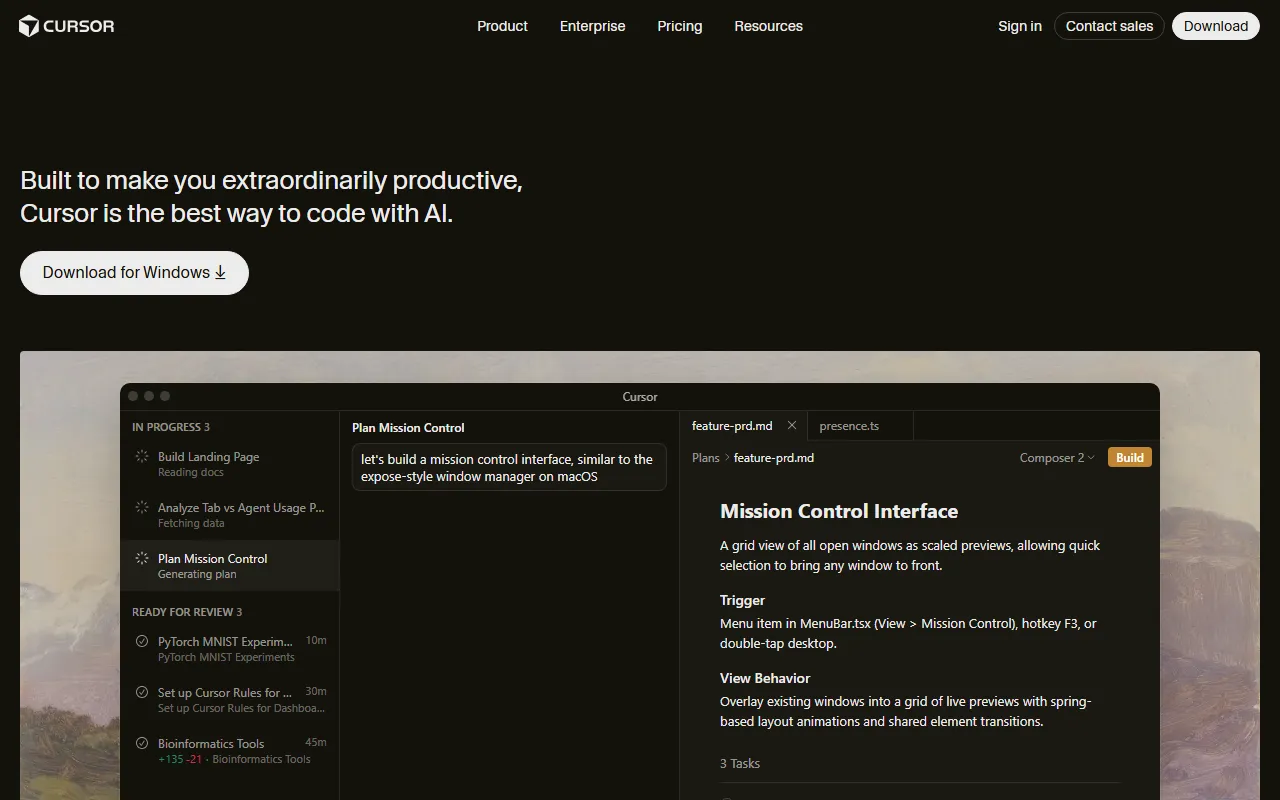

Cursor
Code AssistantsAn AI-first code editor built on VS Code that integrates AI deeply into every aspect of the coding experience, from writing to debugging.
ChatGPT
AI AssistantsOpenAI's conversational AI assistant capable of generating text, answering questions, writing code, and assisting with a wide range of tasks.
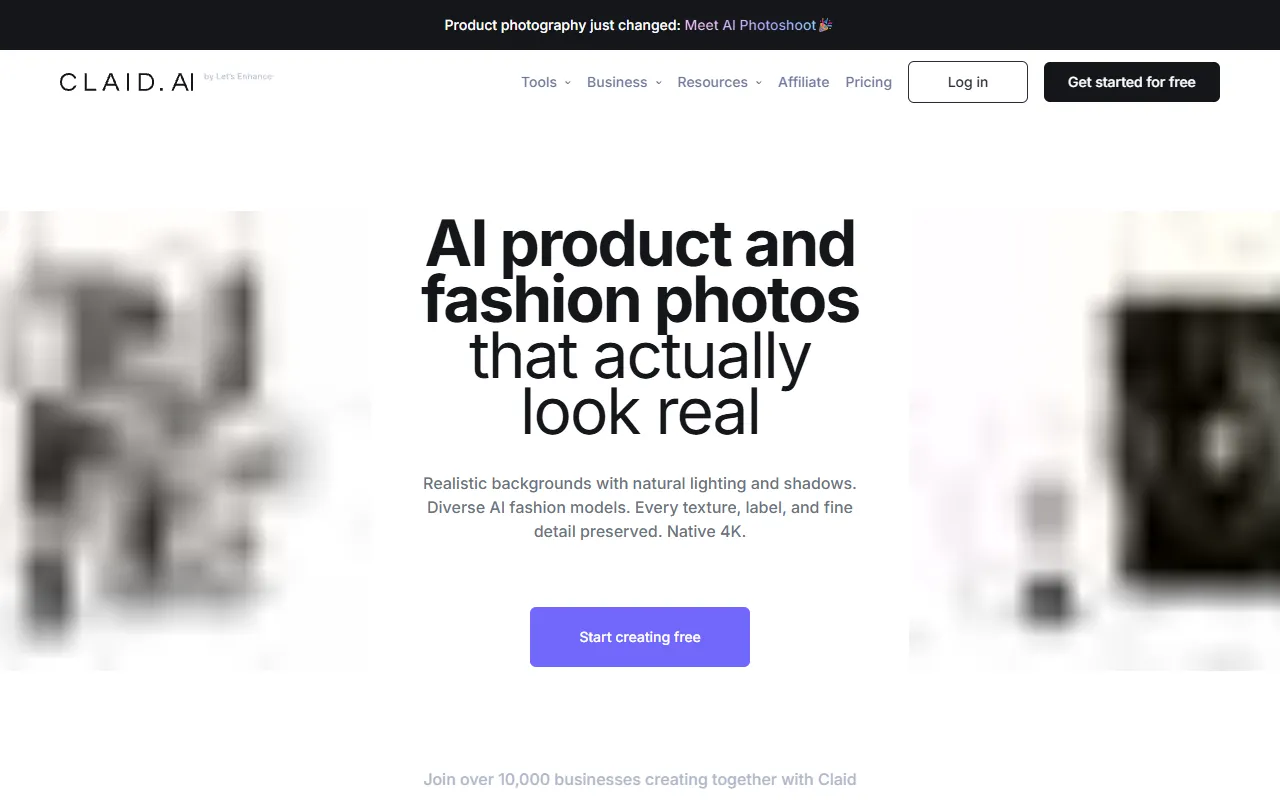
Claid.ai
Image EditingAI product photo editing with automated background removal, upscaling, and enhancement.