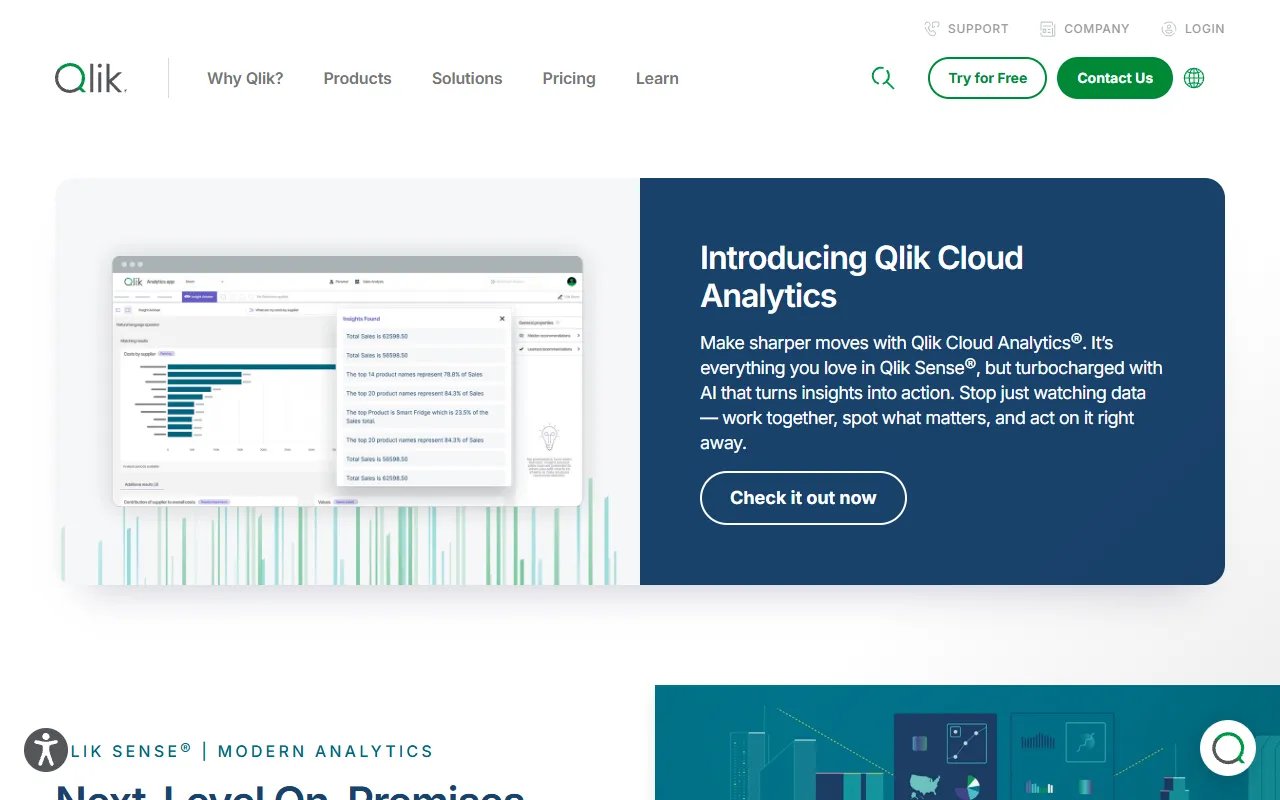
Qlik Sense
AI-powered analytics platform with associative engine and natural language processing queries.
Quick Take
AI-powered analytics platform with associative engine and natural language processing queries.
Pricing
PaidTool Overview
Category
Data Analytics
Pricing
Paid
Official Website
https://www.qlik.com/us/products/qlik-senseReleased
N/A
Tags

What is Qlik Sense?
Qlik Sense is an enterprise-grade analytics and business intelligence platform that uses a patented Associative Engine and AI-powered capabilities to enable users to explore data, discover insights, and make data-driven decisions. Developed by Qlik Technologies, a company founded in Sweden in 1993, Qlik Sense represents the modern evolution of the company's pioneering work in business intelligence. The platform distinguishes itself through its unique associative data model, which allows users to explore data relationships freely without being constrained by predefined queries or hierarchical drill-down paths.
Unlike traditional BI tools that use SQL-based query approaches where users must know what questions to ask in advance, Qlik Sense's Associative Engine keeps all data relationships intact in memory, allowing users to click on any data point and instantly see how it relates to every other piece of data in the model. This approach reveals both the data that is associated with a selection and, critically, the data that is not associated, often surfacing unexpected insights and outliers that would be invisible in traditional query-based analysis. This unique analytical paradigm has earned Qlik a devoted following among data analysts and business users who value exploratory data analysis.
Qlik Sense has increasingly integrated AI and natural language processing capabilities through its Insight Advisor feature, which allows users to ask questions about their data in plain English and receive instant visualizations and analyses. The AI suggests relevant charts, identifies trends and anomalies, and provides narrative explanations of data patterns, making sophisticated analytics accessible to business users who may not have formal data analysis training. The platform also includes advanced AI features for predictive analytics, automated insight generation, and natural language narratives that transform data findings into written summaries.
Key Features
Associative Engine: Qlik's patented Associative Engine is the foundational technology that differentiates the platform from all competitors. It loads all data into an in-memory model that preserves every relationship between data points, enabling truly free-form exploration. When a user makes a selection, the engine instantly highlights associated data in green, potentially associated data in white, and excluded data in gray, providing a visual map of data relationships that reveals both connections and gaps that traditional tools cannot surface.
Insight Advisor with AI: The Insight Advisor feature combines natural language processing with AI-driven analytics to enable conversational data exploration. Users can type questions like "what were the top-selling products last quarter by region" and receive automatically generated visualizations that answer the question. The AI goes beyond simple chart generation to identify statistical trends, detect outliers, perform correlation analysis, and suggest follow-up questions that might reveal deeper insights, acting as an intelligent analytics assistant.
Advanced Data Integration: Qlik Sense provides robust data connectivity and transformation capabilities through its data manager and script editor. The platform connects to hundreds of data sources including databases, cloud services, spreadsheets, APIs, and big data platforms. The data loading script language allows complex data transformations, table joins, and data quality operations, while the visual data manager provides a no-code alternative for simpler data preparation tasks.
Interactive Visualizations: The platform offers a rich library of interactive chart types and visualization options including bar charts, line charts, scatter plots, maps, treemaps, waterfall charts, combo charts, and custom extensions. All visualizations are interactive and responsive to selections made anywhere in the application, instantly updating to reflect the current data context. Custom extensions can be built using the platform's API to create specialized visualizations for specific industry or analytical needs.
Enterprise Governance and Security: Qlik Sense provides comprehensive security features including row-level data security, section access for controlling which users see which data, SAML and JWT authentication, and detailed audit logging. The platform supports multi-tenancy for organizations that need to serve different departments or clients from a single deployment, with governance policies that ensure data access is properly controlled and compliant with regulatory requirements.
How It Works
Implementing Qlik Sense begins with connecting to data sources and building a data model. The platform's data manager provides a visual interface for connecting to databases, files, and cloud services, while the script editor offers more control for complex data loading scenarios. Data from multiple sources is loaded into the Associative Engine, where Qlik automatically detects and establishes relationships between tables based on common field names. Administrators can refine these associations, create calculated dimensions, and define master items that provide a governed layer of reusable analytical building blocks.
Once data is loaded, users create applications that contain sheets of interactive visualizations. The drag-and-drop interface allows users to place charts, tables, and filters onto sheets, binding them to data fields from the model. Every visualization in an application is automatically connected through the Associative Engine, meaning a click on any data point in any chart filters the entire application, providing instant contextual analysis. Advanced users can create complex expressions and calculations using Qlik's powerful expression language, while business users can leverage Insight Advisor to generate visualizations and analyses through natural language interaction.
In daily use, Qlik Sense serves as the analytics hub where teams explore data, generate reports, and make decisions. Applications can be published to managed streams for controlled access, with scheduled data refreshes ensuring that analyses reflect current data. Users access Qlik Sense through a web browser, with responsive design ensuring that applications work on tablets and mobile devices. Alerts and subscriptions keep users informed of important data changes, while the collaborative features allow users to share bookmarks, annotations, and stories that guide colleagues through analytical narratives.
Use Cases
Financial Analysis and Reporting: Finance teams use Qlik Sense for budgeting, forecasting, profitability analysis, and regulatory reporting. The Associative Engine enables finance professionals to explore the relationships between revenue, costs, and profitability across multiple dimensions simultaneously, uncovering margin impacts and cost drivers that might not be visible in traditional financial reports.
Supply Chain Analytics: Operations teams leverage Qlik Sense to monitor supply chain performance, track inventory levels, analyze supplier performance, and optimize logistics. The platform's ability to integrate data from ERP systems, warehouse management systems, and transportation platforms provides a unified view of the entire supply chain, enabling proactive identification of bottlenecks and optimization opportunities.
Sales Performance Management: Sales organizations use Qlik Sense to track pipeline health, forecast revenue, analyze win and loss rates, and optimize territory assignments. The interactive exploration capabilities allow sales managers to quickly identify underperforming segments, high-growth opportunities, and the factors that distinguish successful deals from lost opportunities.
Healthcare Data Analytics: Healthcare organizations deploy Qlik Sense for clinical analytics, patient outcome tracking, operational efficiency analysis, and regulatory compliance reporting. The platform's security features support HIPAA compliance, while the Associative Engine helps healthcare analysts explore complex relationships between patient demographics, treatments, outcomes, and costs.
Pricing
Qlik Sense is available in two primary deployment models: Qlik Sense Business (cloud) and Qlik Sense Enterprise (cloud or on-premises). Qlik Sense Business is priced starting at approximately $30 per user per month and provides full analytics capabilities with cloud hosting. Qlik Sense Enterprise SaaS offers more advanced features including advanced governance, multi-cloud support, embedded analytics APIs, and custom branding, with pricing based on capacity or per-user models that are customized based on the organization's requirements. On-premises Enterprise deployments are available for organizations that require full control over their infrastructure, with licensing models based on tokens or named users. Qlik also offers a free tier called Qlik Cloud Analytics that provides limited data volume and user access for evaluation and small-scale use. Enterprise pricing requires consultation with Qlik sales to receive a customized quote based on deployment size, feature requirements, and user volume.
Pros and Cons
Pros:
The unique Associative Engine provides a fundamentally different and more powerful approach to data exploration than the SQL-based query models used by competing BI platforms, revealing insights that would be invisible in traditional tools.
AI-powered Insight Advisor makes sophisticated analytics accessible to business users through natural language queries, democratizing data analysis without requiring technical skills or knowledge of the underlying data model.
Enterprise-grade security, governance, and scalability features make Qlik Sense suitable for large organizations with strict compliance requirements and complex data access control needs across multiple departments and regions.
Cons:
The learning curve for the data loading script language and expression syntax can be steep, and organizations often need dedicated Qlik developers or significant training investment to build and maintain complex analytical applications.
Pricing for enterprise deployments can be substantial, and the complexity of licensing models with different options for tokens, named users, and capacity-based pricing can make it difficult to predict and manage costs effectively.
Who Is It Best For?
Qlik Sense is best suited for medium to large organizations that need a powerful, enterprise-grade analytics platform capable of handling complex data models and large data volumes. It is particularly valuable for organizations with data-driven cultures where business users need to explore data freely without relying on IT-prepared reports, and for analytical scenarios where discovering unexpected relationships in data is as important as confirming known metrics. Industries with complex data relationships such as finance, healthcare, manufacturing, and retail benefit especially from the Associative Engine's unique ability to surface hidden connections across large, multi-source datasets.
Why Choose Qlik Sense?
Qlik Sense stands out in the business intelligence market through its fundamentally different approach to data analysis. While most BI tools answer questions you already know to ask, the Associative Engine helps you discover questions you did not know to ask, making it uniquely powerful for exploratory analysis and insight discovery. Combined with AI-powered natural language capabilities that make sophisticated analytics accessible to every business user, enterprise-grade governance that satisfies the most demanding compliance requirements, and a proven track record spanning decades of business intelligence innovation, Qlik Sense provides an analytics platform that is both uniquely capable and comprehensively reliable for organizations serious about data-driven decision making.
ADVERTISEMENT
728 x 90
Browse More Tools
View all
Connected Papers
Research ToolsVisual tool for exploring academic paper connections and building literature graphs.

Ironclad
Legal AIAI-powered contract lifecycle management platform for enterprise legal teams.
MindsDB
Data AnalyticsAI platform that brings machine learning directly into your existing databases.
AI Shirt Design Generator - YupTees
AI Image GenerationYupTees: AI-powered T-shirt design generator for fast, easy, and scalable print-on-demand creations.
Claude
AI AssistantsAnthropic's AI assistant known for thoughtful, nuanced responses, strong reasoning capabilities, and a focus on safety and helpfulness.

AlphaFold
Science AIDeepMind AI system that predicts 3D protein structures with remarkable accuracy.

Cursor
Code AssistantsAn AI-first code editor built on VS Code that integrates AI deeply into every aspect of the coding experience, from writing to debugging.
ChatGPT
AI AssistantsOpenAI's conversational AI assistant capable of generating text, answering questions, writing code, and assisting with a wide range of tasks.

Claid.ai
Image EditingAI product photo editing with automated background removal, upscaling, and enhancement.