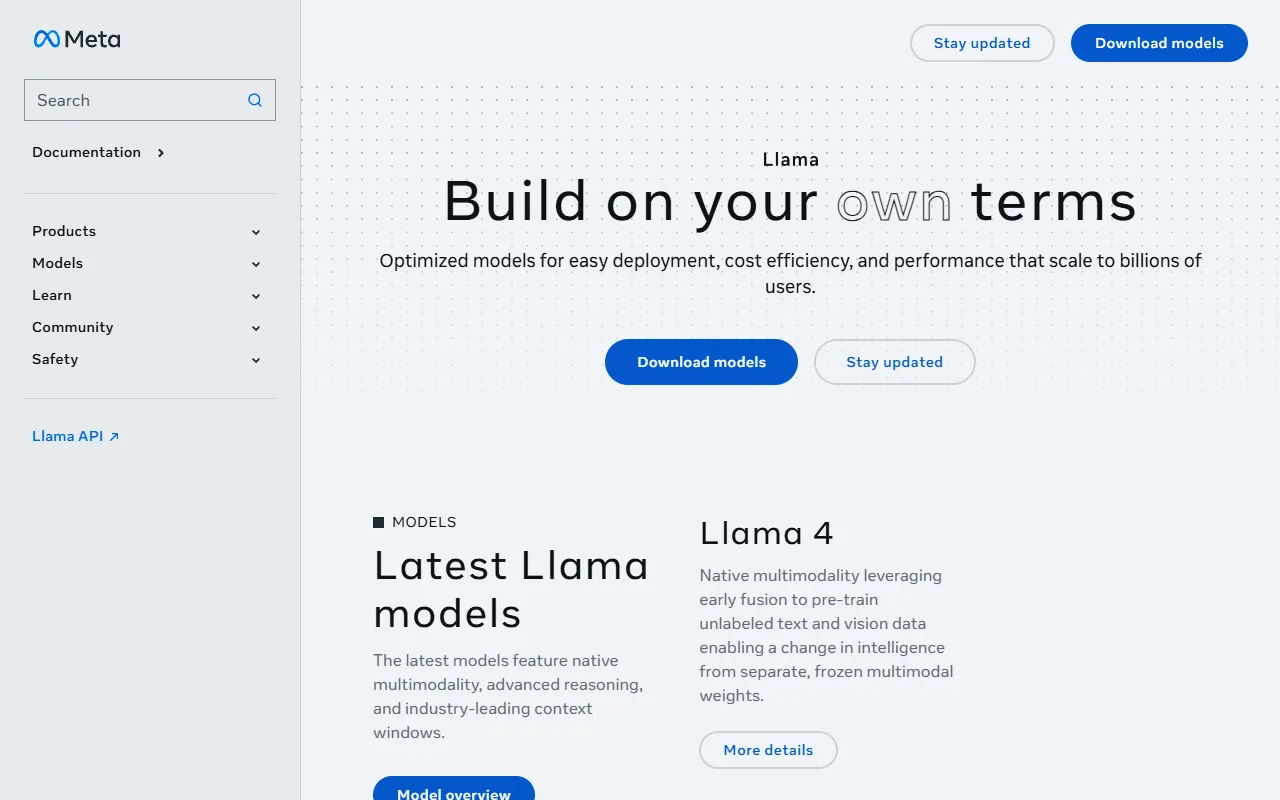
Quick Take
Open-source large language model family from Meta for research and commercial use.
Pricing
FreeTool Overview
Tags
What is Meta Llama?
Meta Llama is a groundbreaking family of open-source large language models developed by Meta AI, the artificial intelligence research division of Meta Platforms (formerly Facebook). Since its initial release in February 2023, Llama has fundamentally reshaped the AI landscape by demonstrating that high-quality, powerful language models can be made freely available to researchers, developers, and businesses worldwide. The name Llama stands for Large Language Model Meta AI, and the project represents one of the most significant contributions to open-source AI in history, enabling thousands of organizations and independent developers to build, customize, and deploy sophisticated AI applications without the massive budgets typically required to train such models from scratch.
Meta's decision to release Llama as an open-source project was a strategic move that has had far-reaching consequences for the AI industry. By making powerful models freely available under permissive commercial licenses, Meta created an alternative to the closed, API-only approach favored by companies like OpenAI and Google. This has sparked an explosion of innovation in the open-source AI community, with thousands of fine-tuned variants, specialized applications, and entirely new projects built on the Llama foundation. The model family has evolved through several major versions, each bringing substantial improvements in capability, efficiency, and versatility.
The Llama model family has grown to include models of various sizes optimized for different use cases and hardware constraints. From compact models that can run on smartphones and edge devices to massive models that rival the performance of the best proprietary systems, the Llama ecosystem offers solutions for virtually every AI deployment scenario. Meta has also expanded the family to include multimodal models capable of understanding images alongside text, as well as specialized models for tasks like code generation and mathematical reasoning.
Key Features
Fully Open-Source with Commercial License: Meta Llama is released under a permissive license that allows both research and commercial use at no cost. Organizations of all sizes can download, deploy, and modify the model without paying licensing fees or per-token API charges. This open approach has made enterprise-grade AI accessible to startups, academic institutions, and developers who previously could not afford proprietary AI services, democratizing access to cutting-edge language model technology.
Multiple Model Sizes: The Llama family includes models ranging from compact versions with around 1 billion parameters to massive versions exceeding 400 billion parameters. This range allows users to select the optimal trade-off between capability and resource requirements for their specific use case. Smaller models can run on consumer GPUs or even mobile devices, while larger models deliver performance that competes with the most capable proprietary systems on challenging benchmarks.
State-of-the-Art Performance: Despite being freely available, Llama models consistently achieve top-tier results on standard AI benchmarks covering reasoning, coding, mathematics, and general knowledge. Later versions of Llama have closed the gap with proprietary models significantly, and in many specific tasks, Llama models match or exceed the performance of paid alternatives. This performance-to-cost ratio makes Llama one of the most efficient choices for organizations building AI-powered products.
Extensive Fine-Tuning Ecosystem: The open-source nature of Llama has spawned an enormous ecosystem of fine-tuned model variants. The community has created thousands of specialized versions optimized for specific tasks such as medical diagnosis assistance, legal document analysis, creative writing, customer service, and many more. Tools like LoRA, QLoRA, and full fine-tuning make it relatively straightforward to customize Llama for any domain, and platforms like Hugging Face host thousands of these community-created variants.
Multimodal Capabilities: Recent Llama releases include vision-language models that can understand and reason about images in addition to text. These multimodal models can analyze photographs, interpret charts and graphs, read text in images, and answer questions that require visual understanding. This expands Llama's utility beyond pure text applications into areas like document understanding, visual question answering, and image-based content moderation.
How It Works
Getting started with Meta Llama is accessible through multiple pathways depending on your technical background and requirements. For developers comfortable with command-line tools, the most direct approach is downloading the model weights from Meta's official distribution channels or from Hugging Face, then running the model using popular inference frameworks like vLLM, Ollama, or Hugging Face Transformers. Ollama in particular has made local Llama deployment remarkably simple, requiring just a single command to download and start chatting with any Llama model on your local machine.
For users who prefer not to manage their own infrastructure, numerous cloud providers offer hosted Llama deployments. AWS Bedrock, Google Cloud Vertex AI, Microsoft Azure, and many other platforms provide managed Llama instances that can be accessed through standard APIs. These cloud deployments eliminate the need for GPU hardware while still providing the benefits of using an open-source model, including competitive pricing compared to proprietary alternatives and the assurance that the model's architecture is publicly auditable.
The fine-tuning process for Llama is well-documented and supported by a rich ecosystem of tools and tutorials. Using techniques like LoRA (Low-Rank Adaptation), developers can customize Llama's behavior for specific tasks using relatively modest hardware, a consumer GPU with 16 GB or more of VRAM is often sufficient for fine-tuning smaller Llama models. The community has produced extensive guides, code examples, and pre-built training pipelines that make the fine-tuning process accessible even to developers with limited machine learning experience.
Use Cases
Enterprise AI Applications: Companies across industries deploy Llama to power internal AI tools, customer-facing chatbots, document processing pipelines, and knowledge management systems. The ability to run Llama on private infrastructure makes it particularly attractive for organizations in regulated industries like healthcare, finance, and government, where data cannot be sent to third-party APIs due to privacy and compliance requirements.
Software Development: Developers use Llama and its code-specialized variants like Code Llama for code generation, code review, bug detection, documentation writing, and learning new programming languages. The model's strong coding capabilities across dozens of languages make it a versatile development assistant that can be integrated into IDEs, CI/CD pipelines, and code review workflows without requiring expensive API subscriptions.
Research and Experimentation: Academic researchers and AI practitioners use Llama as a foundation for studying language model behavior, testing new training techniques, exploring alignment strategies, and developing novel AI applications. The open availability of model weights and architecture details enables research that would be impossible with proprietary models, advancing the collective understanding of how large language models work.
Edge and Mobile Deployment: With smaller Llama models optimized for resource-constrained environments, developers can deploy AI capabilities directly on mobile devices, IoT hardware, and edge servers. This enables offline AI functionality, reduced latency, and complete data privacy for applications ranging from on-device translation to local voice assistants and smart home devices.
Pricing
Meta Llama is entirely free to use. The model weights are available for download at no cost, and the license permits both research and commercial use without licensing fees. Organizations pay only for the computational resources needed to run the model, whether that means purchasing or renting GPU hardware for local deployment or paying cloud providers for hosted instances. When accessed through cloud platforms like AWS Bedrock or Azure, pricing is based on per-token usage and is typically significantly cheaper than comparable proprietary models. For organizations with their own GPU infrastructure, the total cost of running Llama can be reduced to just electricity and hardware amortization costs, making it one of the most cost-effective AI solutions available at any performance level.
Pros and Cons
Pros:
Completely free and open-source with a commercial-friendly license, eliminating vendor lock-in and ongoing API costs
Performance that rivals and sometimes exceeds proprietary models, offering exceptional value for organizations of all sizes
Massive community ecosystem with thousands of fine-tuned variants, tools, and resources available for virtually every use case
Full deployment flexibility from mobile devices to cloud clusters, with support from all major cloud providers and inference frameworks
Cons:
Running the largest and most capable Llama models requires significant GPU hardware investment, which can be a barrier for smaller teams and individual developers
Self-hosting requires technical expertise in model deployment, infrastructure management, and performance optimization that not all organizations possess
While the license is permissive, there are usage restrictions for applications with extremely large user bases (over 700 million monthly active users), which affects only the very largest companies
Who Is It Best For?
Meta Llama is best suited for developers, startups, enterprises, and researchers who want the power of a world-class language model without the constraints and costs of proprietary alternatives. It is the ideal choice for organizations that need to deploy AI on their own infrastructure for privacy, compliance, or cost reasons. Startups benefit from eliminating expensive API bills during their growth phase, enterprises appreciate the ability to customize and control every aspect of the model, and researchers value the transparency and reproducibility that comes with open-source access. If you believe in the principle that powerful AI should be accessible to everyone, Meta Llama is the embodiment of that vision.
Why Choose Meta Llama?
Meta Llama has earned its position as the most important open-source AI model family by consistently delivering exceptional performance while remaining completely free and open. In a market where AI capabilities are increasingly gatekept behind expensive subscriptions and usage-based pricing, Llama represents a fundamentally different approach that empowers developers and organizations to build AI on their own terms. The combination of top-tier performance, total deployment flexibility, a thriving community ecosystem, and zero licensing costs makes Meta Llama the foundation of choice for anyone serious about building AI-powered products and services. Whether you are a solo developer building your first AI application or a Fortune 500 company deploying AI across your entire organization, Llama provides the performance, flexibility, and freedom you need to succeed.
ADVERTISEMENT
728 x 90
Browse More Tools
View all
Connected Papers
Research ToolsVisual tool for exploring academic paper connections and building literature graphs.


Ironclad
Legal AIAI-powered contract lifecycle management platform for enterprise legal teams.
MindsDB
Data AnalyticsAI platform that brings machine learning directly into your existing databases.
AI Shirt Design Generator - YupTees
AI Image GenerationYupTees: AI-powered T-shirt design generator for fast, easy, and scalable print-on-demand creations.
Claude
AI AssistantsAnthropic's AI assistant known for thoughtful, nuanced responses, strong reasoning capabilities, and a focus on safety and helpfulness.
AlphaFold
Science AIDeepMind AI system that predicts 3D protein structures with remarkable accuracy.

Cursor
Code AssistantsAn AI-first code editor built on VS Code that integrates AI deeply into every aspect of the coding experience, from writing to debugging.
ChatGPT
AI AssistantsOpenAI's conversational AI assistant capable of generating text, answering questions, writing code, and assisting with a wide range of tasks.

Claid.ai
Image EditingAI product photo editing with automated background removal, upscaling, and enhancement.